ARK TABLE Get the free plan

How the planning works.

ARK Table does the quiet arithmetic of a family week: who’s eating, how much, what to buy and what it costs. Here is each step, plainly.

Set up your household.

Tell ARK who sits at your table: adults and children, bigger and smaller appetites, foods each person skips, and how much time you have on a weeknight. You do this once and change it whenever life does.

  • Up to 6 profiles on ARK Family
  • Allergens you want to avoid are flagged on every recipe
  • Weeknight time limits shape what’s suggested

A note on allergies

ARK lists each recipe’s allergens and flags dishes that contain ones you’ve chosen to avoid. It can’t guarantee a meal is safe for an allergy. Always check labels and cross-contact.
Portions, per person.

Instead of “serves four”, ARK sizes each dinner for the people actually eating it. A teenager and a toddler don’t eat the same plate, so the recipe and the shopping scale to your household.

Planned leftovers are deliberate: cook once, and Wednesday’s lunch is already counted.

Why it matters

Buying for the people you actually feed, not a generic serving count, keeps the list honest and the fridge free of forgotten extras.

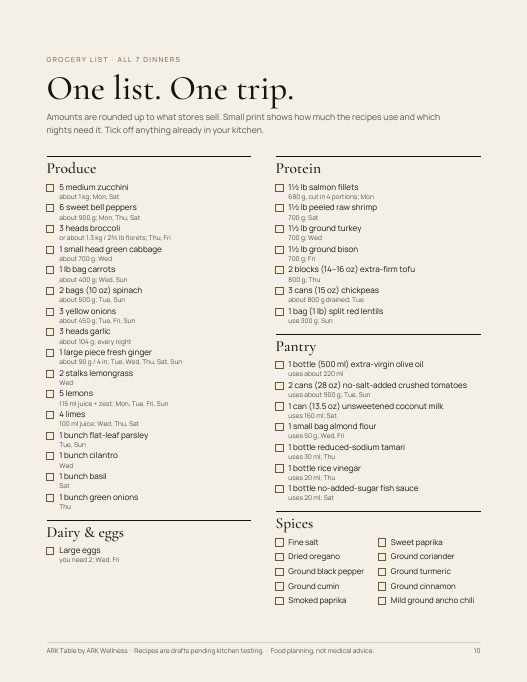
One store-ready grocery list.

The week’s recipes combine into a single list, grouped by aisle, in the amounts stores actually sell: one bunch, a two-pound pack, a 15-ounce can. Tick off what’s already in your pantry and the list shrinks.

  • Works with any grocery store
  • Print it, or keep it on your phone
  • Bulk-buy guide on ARK Family
A page from the free plan: one combined grocery list grouped by Produce, Protein, Dairy, Pantry and Spices
From the free 7-day plan

The meters.

Savings. ARK sets your planned week against the USDA’s published family food budgets. For a family of four, the gap between the moderate-cost and thrifty plans is up to $4,400 a year.* Your own number depends on what you spend now.

Real food. The share of the week’s ingredients that are whole or minimally processed. It scores the food on the plan, not you, and it isn’t a health assessment.

What the meters aren’t

They’re planning tools. They don’t measure your health, predict outcomes or guarantee savings.

Noah, with guardrails.

Noah is the AI kitchen assistant inside ARK Table. Ask it to swap a dinner, work around what’s in the fridge, trim the budget, or scale a recipe for guests. Your first 3 actions are free.

Noah is built to stay in its lane. When a question is about a medical condition, a diagnosis, medication or a therapeutic diet, Noah says so and refers you to a registered dietitian or your doctor.

Noah won’t

  • DiagnoseNo reading symptoms, labs or conditions.
  • Recommend supplementsFood only, from whole ingredients.
  • Call a meal “allergy safe”It flags allergens; you check labels.

See it with your own week.

Start with the free 7-day plan: seven dinners, one list, ready in a minute.

Get the free 7-day plan

*Illustrative. The USDA Food Plans put a family of four at about $1,386.70 a month on the moderate-cost plan and $1,018.20 on the thrifty plan (figures as reported July 2026). Over 12 months the gap is just over $4,400, which we show as “up to $4,400 a year” and never more. Your savings depend on what you spend now and will vary. This is a planning comparison, not measured savings or a guarantee. Source: USDA Food Plans: Cost of Food reports.